Showing posts with label volt. Show all posts
Showing posts with label volt. Show all posts
Wednesday, December 18, 2013
Build a high volt supply Circuit Diagram
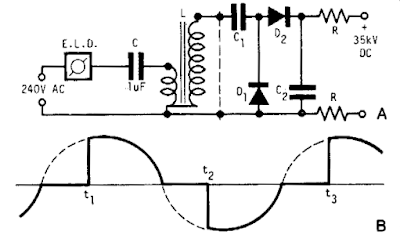
A light dimmer, a 1 µf capacitor and a 12 V car ignition coil form the simple line powered HV generator. The current in the dimmer is shown in Fig. B. At times tp t2, set by the dimmer switch, the inner triac of the dimmer switches on, and a very high and very fast current pulse charges the capacitor through the primary of the induction coil.
Then at a rate of 120 times per second for a 60 Hz line, a very high voltage pulse appears at the secondary of the coil. To obtain an HV dc output, use a voltage doubler. Dl and D2 are selenium rectifiers (TV 18 Siemens or ITT) used for the supply of television sets. High value output shock protection resistors, R, are recommended when suitable.
Build a high-volt supply Circuit Diagram

Thursday, April 11, 2013
Simple Transformerless 5 Volt Power Supply
Description
An increasing number of appliances draw a very small current from the power supply. If you need to design a mains powered device, you could generally choose between a linear and a switch-mode power supply. However, what if the appliance’s total power consumption is very small? Transformer-based power supplies are bulky, while the switchers are generally made to provide greater current output, with a significant increase in complexity, problems involving PCB layout and, inherently, reduced reliability.
Is it possible to create a simple, minimum part-count mains (230 VAC primary) power supply, without transformers or coils, capable of delivering about 100 mA at, say, 5 V A general approach could be to employ a highly inefficient stabilizer that would rectify AC and, utilizing a zener diode to provide a 5.1 V output, dissipate all the excess from 5.1 V to (230×v2) volts in a resistor. Even if the load would require only about 10 mA, the loss would be approximately 3 watts, so a significant heat dissipation would occur even for such a small power consumption.
At 100 mA, the useless dissipation would go over 30 W, making this scheme completely unacceptable. Power conversion efficiency is not a major consideration here; instead, the basic problem is how to reduce heavy dissipation and protect the components from burning out. The circuit shown here is one of the simplest ways to achieve the above goals in practice. A JVR varistor is used for overvoltage/surge protection. Voltage divider R1-R2 follows the rectified 230 V and, when it is high enough, T1 turns on and T3 cannot conduct.
Circuit diagram:

When the rectified voltage drops, T1 turns off and T3 starts to conduct current into the reservoir capacitor C1. The interception point (the moment when T1 turns off) is set by P1 (usually set to about 3k3), which controls the total output current capacity of the power supply: reducing P1 makes T1 react later, stopping T3 later, so more current is supplied, but with increased heat dissipation. Components T2, R3 and C2 form a typical ‘soft start’ circuit to reduce current spikes this is necessary in order to limit C1’s charging current when the power supply is initially turned on. At a given setting of P1, the output current through R5 is constant.
Thus, load R4 takes as much current as it requires, while the rest goes through a zener diode, D5. Knowing the maximum current drawn by the load allows adjusting P1 to such a value as to provide a total current through R5 just 5 to 6 mA over the maximum required by the load. In this way, unnecessary dissipation is much reduced, with zener stabilization function preserved. Zener diode D5 also protects C1 from over voltages, thus enabling te use of low-cost 16 V electrolytics.
The current flow through R5 and D5, even when the load is disconnected, prevents T3’s gate-source voltage from rising too much and causing damage to device. In addition, T1 need not be a high-voltage transistor, but its current gain should exceed 120 (e.g. BC546B, or even BC547C can be used).
CAUTION!
The circuit is not galvanically isolated from the mains. Touching any part of the circuit (or any circuitry it supplies power to) while in operation, is dangerous and can result in an electric shock! This circuit should not be built or used by individuals without proper knowledge of mains voltage procedures.
Copyright: Elektor Electronics Magazine
Author: Srdjan Jankovic & Branko Milovanovic
Author: Srdjan Jankovic & Branko Milovanovic
Thursday, April 4, 2013
Volt Outlets Volt Outlets Wiring Diagram Symbols Page

110 Volt Outlets 220 Volt Outlets Wiring Diagram Symbols Top Of Page.

Gfci Outlet Wiring Diagram.

Mains Powered White Led Lamp Circuit Diagram.

Instructions On How To Wire A Dryer.

Wiring Jvc Stereo Wiring To A Ford Escape Pics Wiring Diagram.

Wire Systems.

Wiring A 220 Volt Clothes Dryer Ask Me Help Desk.

Bmw E46 Wiring Diagrams Group Picture Image By Tag.

Converting Electric Clothes Dryer 3 Prong Cords To 4 Prong Cords.
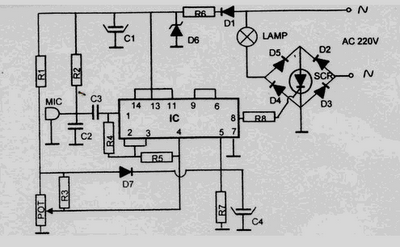
220 Volt Disco Lamp Circuit Schematic Diagram Wiring Diagram.
Friday, March 29, 2013
Dual Polarity 5 Volt Converter Using LM2685
A symmetrical ±5V power supply is often needed for small, battery-operated operational amplifier projects and analogue circuits. An IC that can easily be used for this purpose is the National Semiconductor LM2685. It contains a switched-capacitor voltage doubler followed by a 5-V regulator. A voltage inverter integrated into the same IC, which also uses the switched-capacitor technique, runs from this output voltage. The external circuitry is limited to two pump capacitors and three electrolytic storage capacitors.
The IC can work with an input voltage between +2.85V and +6.5V, which makes it well suited for battery-operated equipment. The input voltage is first applied to a voltage doubler operating at 130kHz. The external capacitor for this is connected to pins 13 and 14. The output voltage of this doubler is filtered by capacitor C3, which is connected to pin 12. If the input voltage lies between +5.4 and +6.5V, the voltage doubler switches off and passes the input voltage directly through to the following +5V low-dropout regulator, which can deliver up to 50mA. C4 is used as the output filter capacitor.
 All that is necessary to generate the –5-V output voltage is to invert the +5-V voltage. This is done by a clocked power-MOS circuit that first charges capacitor C2, which is connected between pins 8 and 9, and then reverses its polarity. This chopped voltage must be filtered by C5 at the output. The unregulated –5V output can supply up to 15mA. The LM 2865 voltage converter IC also has a chip-enable input (CE) and two control inputs, SDP (shut down positive) and SDN (shut down negative). If CE is set Low, the entire IC is switched off (shut down), and its current consumption drops to typically 6µA.
The CE input can thus be used to switch the connected circuit on or off, without having to disconnect the battery. The SDP and SDN inputs can be used to switch the VPSW and VNSW outputs, respectively. These two pins are connected to the voltage outputs via two low-resistance CMOS switches. This allows the negative output to be separately switched off, whereby the voltage inverter is also switched off. Switching off with SDP not only opens the output switch but also stops the oscillator.
There is thus no longer any input voltage for the –5V inverter, so the –5V output also drops out. The SDP and SDN inputs are set Low (<0.8v)>2.4V) for switching off the associated voltage(s). The positive output of the LM 2865 is short-circuit proof. However, a short circuit between the positive and negative outputs must always be avoided. The IC is protected against thermal destruction by an over-temperature monitor. It switches off automatically at a chip temperature of around 150C. The full type number of the IC is LM2685MTC. It comes in a TSSOP14 SMD package. National Semiconductor can be found on the Internet under www.national.com.
Read More..
The IC can work with an input voltage between +2.85V and +6.5V, which makes it well suited for battery-operated equipment. The input voltage is first applied to a voltage doubler operating at 130kHz. The external capacitor for this is connected to pins 13 and 14. The output voltage of this doubler is filtered by capacitor C3, which is connected to pin 12. If the input voltage lies between +5.4 and +6.5V, the voltage doubler switches off and passes the input voltage directly through to the following +5V low-dropout regulator, which can deliver up to 50mA. C4 is used as the output filter capacitor.
 All that is necessary to generate the –5-V output voltage is to invert the +5-V voltage. This is done by a clocked power-MOS circuit that first charges capacitor C2, which is connected between pins 8 and 9, and then reverses its polarity. This chopped voltage must be filtered by C5 at the output. The unregulated –5V output can supply up to 15mA. The LM 2865 voltage converter IC also has a chip-enable input (CE) and two control inputs, SDP (shut down positive) and SDN (shut down negative). If CE is set Low, the entire IC is switched off (shut down), and its current consumption drops to typically 6µA.
The CE input can thus be used to switch the connected circuit on or off, without having to disconnect the battery. The SDP and SDN inputs can be used to switch the VPSW and VNSW outputs, respectively. These two pins are connected to the voltage outputs via two low-resistance CMOS switches. This allows the negative output to be separately switched off, whereby the voltage inverter is also switched off. Switching off with SDP not only opens the output switch but also stops the oscillator.
There is thus no longer any input voltage for the –5V inverter, so the –5V output also drops out. The SDP and SDN inputs are set Low (<0.8v)>2.4V) for switching off the associated voltage(s). The positive output of the LM 2865 is short-circuit proof. However, a short circuit between the positive and negative outputs must always be avoided. The IC is protected against thermal destruction by an over-temperature monitor. It switches off automatically at a chip temperature of around 150C. The full type number of the IC is LM2685MTC. It comes in a TSSOP14 SMD package. National Semiconductor can be found on the Internet under www.national.com.
Thursday, March 28, 2013
9 Volt 2 Ampere DC Power Supply Circuit Diagram
A simple 9 Volt 2 amp supply using a single IC regulator.
There is little to be said about this circuit. All the work is done by the regulator. The 7809 can deliver up to 2 amps continuous output whilst maintaining a low noise and very well regulated supply. The circuit will work without the extra components, but for reverse polarity protection a 1N5400 diode (D1) is provided at the input, extra smoothing being provided by C1. The output stage includes C2 for extra filtering, if powering a logic circuit than a 100nF (C3) capacitor is also desirable to remove any high frequency switching noise.
Circuit diagram:

C1 = 100uF-25V electrolytic capacitor, at least 25V voltage rating
C2 = 10uF-25V electrolytic capacitor, at least 6-16V voltage rating
C3 = 100nF-63V ceramic or polyester capacitor
IC = 7809 Positive Voltage Regulator IC
D1 = 1N5400 Diode
Read More..
There is little to be said about this circuit. All the work is done by the regulator. The 7809 can deliver up to 2 amps continuous output whilst maintaining a low noise and very well regulated supply. The circuit will work without the extra components, but for reverse polarity protection a 1N5400 diode (D1) is provided at the input, extra smoothing being provided by C1. The output stage includes C2 for extra filtering, if powering a logic circuit than a 100nF (C3) capacitor is also desirable to remove any high frequency switching noise.
Circuit diagram:

9 Volt 2 amp DC Power Supply Circuit Diagram
Parts:C1 = 100uF-25V electrolytic capacitor, at least 25V voltage rating
C2 = 10uF-25V electrolytic capacitor, at least 6-16V voltage rating
C3 = 100nF-63V ceramic or polyester capacitor
IC = 7809 Positive Voltage Regulator IC
D1 = 1N5400 Diode
Subscribe to:
Posts (Atom)