Showing posts with label 12v. Show all posts

Sunday, August 4, 2013

12V Halogen Lamp Electronics Transformer Circuit Diagram

A halogen lamp is a source of electric light that works by heat-driven light emissions produce from the combination of the halogen gas and the tungsten filament. Below schematic shows the 12V Halogen Lamp Electronics Transformer Circuit Diagram.
The following file is an application note from ST.com containing description of the 12V Halogen Lamp Electronics Transformer Circuit Diagram. These lamps are available with voltage ratings of 6, 12 or 24 Volts, and so a transformer is needed in order to provide the lamp with a low voltage supply from either 110V a.c. or 220V a.c. mains.
The topology of the circuit is the classic half-bridge. The line voltage is rectified by the full-bridge rectifier, generating a semi-sinusoidal voltage at double the line frequency.
Get more information regarding the 12V Halogen Lamp Electronics Transformer Circuit Diagram design here.
Read More..

Friday, July 12, 2013

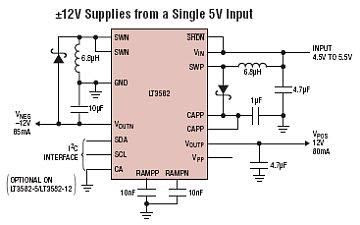
Build a LT3582 12 DC 5V to 12V DC Converter

Using LT3582-12 dual channel DC DC converter integrated circuit, manufactured by Linear Technology, can be designed a very simple step up dc converter. This 5 to 12V c converter electronic project provide both positive and negative outputs required in many biasing applications such as active matrix OLED (organic light-emitting diode)displays as well as CCD (charge coupled device) applications.

Build a LT3582-12 DC 5V to 12V DC Converter

The LT3582 offer an I2C interface that can dynamically program output voltages, power sequencing and output voltage ramps as the application requires. The LT3582’s positive output voltage can be set between 3.2V and 12.775 in 25mV steps, whereas the negative output can be set between -1.2V and -13.95V in 50mV steps. The LT3582-12 is preconfigured with ±12V output, requiring no future programming.
Read More..

Saturday, April 6, 2013

12V Flourescent Lamp Inverter

Fluorescent tubes use far less energy than incandescent lamps and fluorescent tubes last a great deal longer as well. Other advantages are diffuse, glare-free lighting and low heat output. For these reasons, fluorescent lighting is the natural choice in commercial and retail buildings, workshops and factories. For battery-powered lighting, fluorescent lights are also the first choice because of their high efficiency. The main drawback with running fluorescent lights from battery power is that an inverter is required to drive the tubes.

Circuit diagram:

12-volt-flourescent-lamp-Inverter-circuit
12V Fluorescent Lamp Inverter Circuit Diagram
Fig.1: two switch-mode circuits are involved here: the DC-DC inverter involving IC1, Q1 & Q2 and the fluoro tube driver which converts high voltage DC to AC via IC3 and Q3 & Q4 in a totem-pole circuit.
Inverter efficiency then becomes the major issue. There are many commercial 12V-operated fluorescent lamps available which use 15W and 20W tubes. However, it is rare to see one which drives them to full brilliance. For example, a typical commercial dual 20W fluorescent lamp operating from 12V draws 980mA or 11.8W. Ignoring losses in the fluorescent tube driver itself, it means that each tube is only supplied with 5.9W of power which is considerably less than their 20W rating. So while the lamps do use 20W tubes, the light output is well below par.

Warning:

This circuit generates in excess of 300V DC which could be lethal. Construction should only be attempted by those experimenced with mains-level voltages and safety procedures.
Source: www.siliconchip.com
Read More..

Saturday, March 30, 2013

12V Speed Controller Dimmer

This handy circuit can be used as a speed controller for a 12V motor rated up to 5A (continuous) or as a dimmer for a 12V halogen or standard incandescent lamp rated up to 50W. It varies the power to the load (motor or lamp) using pulse width modulation (PWM) at a pulse frequency of around 220Hz.  SILICON CHIP has produced a number of DC speed controllers over the years, the most recent being our high-power 24V 40A design featured in the March & April 2008 issues. Another very popular design is our 12V/24V 20A design featured in the June 1997 issue and we have also featured a number of reversible 12V designs.
 
Project Image :
12v-speed-controllerdimmer pro
 12V Speed Controller/Dimmer Project Image

For many applications though, most of these designs are over-kill and a much simpler circuit will suffice. Which is why we are presenting this basic design which uses a 7555 timer IC, a Mosfet and not much else. Being a simple design, it does not monitor motor back-EMF to provide improved speed regulation and nor does it have any fancy overload protection apart from a fuse. However, it is a very efficient circuit and the kit cost is quite low.

Parts layout:

12v-speed-controllerdimmer2_Parts layout

Connection diagram:

12v-speed-controllerdimmer3_Connection diagram

There are many applications for this circuit which will all be based on 12V motors, fans or lamps. You can use it in cars, boats, and recreational vehicles, in model boats and model railways and so on. Want to control a 12V fan in a car, caravan or computer? This circuit will do it for you. The circuit uses a 7555 timer (IC1) to generate variable width pulses at about 210Hz. This drives Mosfet Q3 (via transistors Q1 & Q2) to control the speed of a motor or to dim an incandescent lamp.

Circuit diagram :
12v-speed-controllerdimmer Circuit diagram
12V Speed Controller/Dimmer Circuit Diagram

While the circuit can dim 12V halogen lamps, we should point out that dimming halogen lamps is very wasteful. In situations where you need dimmable 12V lamps, you will be much better off substituting 12V LED lamps which are now readily available in standard bayonet, miniature Edison screw (MES) and MR16 halogen bases. Not only are these LED replacement lamps much more efficient than halogen lamps, they do not get anywhere near as hot and will also last a great deal longer.

Source : Streampowers
Read More..