Showing posts with label regulator. Show all posts

Thursday, July 11, 2013

Digital Clock with Timer and Solar Panel Regulator

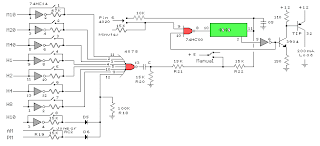
This is a combination digital clock timer and solar panel charge controller used to maintain a deep cycle battery from a solar panel. The timer output is used to control a 12 volt load for a 32 minute time interval each day. Start time is set using 9 dip switches and ends 32 minutes later. The 32 minute duration is set by selecting the 5th bit (2^5 = 32) of a 4040 binary counter (pin 2). The timer also has a manual toggle switch so the load can be manually switched on or off and automatically shuts off after 32 minutes. The time duration can be longer or shorter (8,16,32,64,128,256 minutes etc.) by selecting the appropriate bit of the counter. The timer circuit is shown in the lower schematic just above the regulator.  

Basic Clock Circuit diagram


Digital Clock with Timer and Solar Panel Regulator


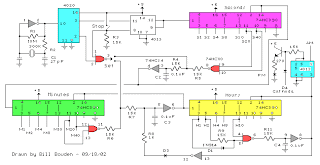
The basic clock circuit (top schematic below) is similar to the binary clock (on another page) and uses 7 ICs to produce the 20 digital bits for 12 hour time, plus AM and PM. A standard watch crystal oscillator (32,768) is used as the time base and is divided down to 1/2 half second by the 4020 binary counter. One half of a 4013 data latch is used to divide the 1/2 second signal by 2 and produce a one second pulse that drives the seconds counter (74HC390 colored purple). The minutes are advanced by decoding 60 seconds (40 + 20) and then resetting the seconds counter to 0 and at the same time advancing the minutes counter. The same procedure is used to advance the hours. The second half of the 4013 latch is used to indicate AM or PM and is toggled by decoding 13 hours and resetting the hours to 0 and then advancing the hours to "one".


Clock Display Circuit diagram
Digital Clock with Timer and Solar Panel Regulator


The clock display circuit is shown in the second drawing below and uses 6 more ICs to decode the binary data and drive four seven segment LED displays. The 10s of hours digit is driven with a single 3904 transistor. Two multiplexer circuits (4053) are used to manually select either minutes or seconds for the right two display digits. The two switches shown between the 4053s and below the left 4053 are both part of one DPDT switch which selects either seconds or minutes for the 1X and 10X digits. This switch is shown in the seconds position and the hours digits are blanked with a low signal on pin 4 of the 4511.

The display can also be toggled on and off (totally blank) using a set/reset latch made from a couple 74HC00 NAND gates. A momentary DPDT switch is used to control the latch and toggle the display on or off. The second pole of this switch is used on the upper drawing (connected to the run/stop switch) to set the hours and minutes. Thus this same switch performs both functions of blanking the display and setting the time. The run/stop switch is shown in the normal running mode and supplies a low signal to a NAND gate which prevents accidental setting the time while the clock is running.

 Clock Timer Circuit diagram


Digital Clock with Timer and Solar Panel Regulator


The run/stop switch also turns on the display (through the diode D2) when in the stop position. The procedure for setting the clock would be to set the (run/stop) switch the stop position and the (seconds/minutes) switch to the minutes position. Then toggle the momentary switch to set minutes and hours of the current time plus one minute. The clock can then be started with the run/stop switch at precisely the right time (+/- 0.5 seconds).

Voltage Regulator (13.6 volts)

Digital Clock with Timer and Solar Panel Regulator


The voltage regulator in the lower drawing maintains the battery at 13.6 volts and also supplies the clock and timer circuits with 4.3 volts. The charge LED indicator only comes on when the regulator is supplying max charge to the battery. When the battery voltage reaches 13.6 the regulator reduces the current to whatever is necessary to maintain the voltage and the charge indicator will turn off. The unit I built also included a battery condition indicator (voltmeter using 4 LEDs) to indicate the battery condition so that a failure of the regulator would be indicated by the charge indicator LED turned off and less than 4 LEDs lit on the voltmeter.
Read More..

Wednesday, July 10, 2013

LED Torch using NSI45090JDT4G Constant Current Regulator

A very simple LED torch can be designed using the NSI45090JDT4G adjustable constant current regulator (CCR) designed by ON Semiconductor ,using extreme few external components. NSI45090JDT4G device is designed to provide a cost effective solution for regulating current in LEDs. This Constant current regulator is based on patent-pending Self-Biased Transistor (SBT) technology and regulates current over a wide voltage range. It is designed with a negative temperature coefficient to protect LEDs from thermal runaway at extreme voltages and currents.

LED Torch Circuit Diagram


LED Torch using NSI45090JDT4G Constant Current Regulator

The Radj pin allows Ireg(SS) to be adjusted to higher currents by attaching a resistor between Radj (Pin 3) and the Cathode (Pin 4). The Radj pin can also be left open (No Connect) if no adjustment is required.The maximum current that can be adjusted using this chip is around 160 mA , and the maximum input voltage is around 45 volts The D1 from the circuit shown here is used for reverse battery protection .

Bellow you can see how simple is to design a circuit using this chip ( all data shown bellow are for this schematic ) .
LED’s = ((Vin − QX VF − D1 VF)/LED VF)
Example: Vin = 12 Vdc, QX VF = 3.5 Vdc, D1VF = 0.7 V
LED VF = 2.2 Vdc @ 30 mA
(12 Vdc − 4.2 Vdc)/2.2 Vdc = 3 LEDs in series.
Read More..

Saturday, April 13, 2013

Remote Controlled Fan Regulator Circuit Diagram

Using this circuit, you can trade the velocity of the fan from your sofa or mattress. Infrared obtainr module TSOP1738 is used to obtain the infrared sign transmitted by using remote keep a watch on. The circuit is powered with the aid of regulated 9V. The AC primarys is stepped down by using transformer X1 to deliver a secondary output of 12V-0-12V. The transformer output is rectified by using full-wave rectifier comprising diodes D1 and D2, filtered via capacitor C9 and regulated through 7809 regulator to provide 9V regulated output. Any button on the remote can be used for keep watch overling the pace of the fan. Pulses from the IR receiver module are utilized as a set off sign to timer NE555 (IC1) by the use of LED1 and resistor R4.

Circuit Diagram :
Remote-Controlled Fan Regulator Circuit Diagram

IC1 is wired as a monostable multivibrator to prolong the clock given to decade counter-cum-driver IC CD4017 (IC2).Out of the ten outputs of decade counter IC2 (Q0 thru Q9), handiest 5 (Q0 through Q4) are used to control the fan. Q5 output shouldn't be used, while Q6 output is used to reset the counter. Another NE555 timer (IC3) can additionally be wired as a monostable multivibrator. Combination of one of the most resistors R5 via R9 and capacitor C5 controls the pulse width.  The output from IC CD4017 (IC2) is applied to resistors R5 via R9. If Q0 is excessive capacitor C5 is charged via resistor R5, if Q1 is high capacitor C5 is charged through resistor R6, and so on.

Optocoupler MCT2E (IC5) is wired as a zero-crossing detector that supplies trigger pulses to monostable multivibrator IC3 all over zero crossing. Opto-isolator MOC3021 (IC4) drives triac BT136. Resistor R13 (47-ohm) and capacitor C7 (0.01µF) mixture is used as snubber network for triac1 (BT136). As the width of the heart beat lowers, firing attitude of the triac increases and velocity of the fan also increases. Thus the rate of the fan increases when we press any button on the faraway control. Assemble the circuit on a general-purpose PCB and house it in a small case such that the infrared sensor can easily receive the signal from the far flung transmitter.


http://www.ecircuitslab.com/2011/09/remote-controlled-fan-regulator-circuit.html
Read More..

Wednesday, April 10, 2013

High Input Voltage Linear Regulator

Commonly used 3-pin linear voltage regulators, for example the LM317, cannot handle input voltages in excess of about 30V. The LR8A from Supertex Inc is a new, adjustable three pin regulator that can accept input voltages up to 450V and can supply an output current of 0.5mA to 10mA. Using this device it is possible to work with rectified 230VAC. The LR8 has a wide input voltage range of +12 V to +450V. Two external resistors (R1 and R2) allow the output voltage to be adjusted from 1.20 V to 440 V provided that the input voltage is at least 10 V greater than the output voltage. The LR8 adjusts the voltage difference between the Vout and ADJ pins to a nominal value of 1.20V.

High Input Voltage Linear Regulator circuit diagramThis 1.20V is amplified by the external resistor ratio of R1 and R2. An internal constant bias current of 10µA is connected to the ADJ pin so that Vout is increased by a constant voltage of 10µA times R2. The formula for calculating the output voltage is given next to the circuit diagram. To ensure stable operation of the regulator a minimum output current of 500µA is necessary and a bypass capacitor of minimum 1.0µF should be used. Protection circuits in the LR8 limit the output current to 15mA typically and temperature protection ensures that the device temperature will not exceed 125oC.

High Input Voltage Linear RegulatorWhen the device reaches its temperature limit, the output voltage/current will decrease to keep the junction temperature within limits. The two circuit diagrams show the LR8 used as a voltage regulator and as a constant current source. The current source can be used to a drive an LED. This configuration would give an LED with super-wide input voltage range, i.e., from +12V to +450V. The LR8 was originally designed to be used for switch mode supply start-up applications so it incorporates a feature which shuts down the LR8 when the output voltage exceeds the input voltage. Diode D1 is therefore necessary in the voltage regulator circuit diagram to prevent the output voltage exceeding the input voltage at any time.

LR8 PinoutThe minimum value of the input capacitor C1 can be calculated from the following formula: C1(min) = (IL t ) / (Vpk – Vout – 10V) Where IL is the load current, and t the period between two voltage peaks. At 50 Hz, using one rectifying diode this will give a value t = 20 ms. Vpk is the peak input voltage, while Vout is the selected output voltage. The LR8 is available in two package outlines. The LR8N8 is a SOT89 SMD package while the LR8N3 is the familiar TO92 Transistor outline (e.g. BC 238). The TO-92 package can dissipate a maximum of 0.74W while with suitable heatsinking, the SMD package can dissipate 1.6W.
Read More..

Friday, March 29, 2013

Automatic Temperature Climate Controlled Mains Fan Regulator Dimmer Circuit

The following circuit of a temperature or climate controlled fan speed regulator circuit was requested by one of the  followers of this blog Mr.Anil Kumar. Lets learn more about the request and the proposed design.


The Request

Hi Swagatam,

am doing project on automatic speed control of ceiling fan depending on temperature. am an engineering student. can help me abt circuit and all. please...


The Design

As can be seen in the given diagram, a very simple concept has been implemented in the proposed design of a climate controlled or temperature controlled fan regulator circuit.

A1, A2, and A3 are the 3 opamps from the IC LM324 which are configured as voltage comparators and amplifier.

The diode D1 which is a common "garden diode" has a very interesting "drawback", it changes its forward voltage drop by 2mV in response to every degree rise in the ambient temperature or the temperature surrounding it.

The above drawback of the device becomes our benefit here, because the feature here is exploited for sensing the ambient temperature of the premise.

The varying voltage across D1, in response to the varying surrounding temperature is effectively amplified at the output of A3.

The above amplified response is fed over an LED/LDR opto coupler, where the LED becomes the output load of A3.

Therefore the brightness of the LED varies proportionately in response to the temperature variations, it becomes brighter with increasing temperature and vice versa.

The above illumination falls over the built in LDR of the opto, which in turn varies its resistance according to the above information from D1.

Since the LDR is fixed as the gate control resistor of the dimmer circuit consisting of R11, C5, R13, DC1 and the TR1, the voltage across TR1 starts regulating the mains AC in accordance with the fed LED/LDR response.

When the LED is bright (at higher temperatures), the LDR resistance lowers. allowing the triac to pass more current. This increases the speed of the fan, and when the LED/LDR response decreases (at lower temperatures), the speed of the fan also decreases.

A compact power supply consisting of C3, C2, Z1 supplies the required filtered DC to the IC LM324 temperature sensor configuration for the intended operations.

Idealy P1 should be adjusted such that the LED just begins glowing at about 24 degree Celsius, initiating the rotation of the fan at the minimum level.

D1 must be kept exposed well outside the enclosure so that it is able to sense the fan breeze directly.


WARNING - THE CIRCUIT IS NOT ISOLATED FROM MAINS AC...... BE VERY MUCH CAUTIONED WHILE BUILDING AND TESTING THIS CIRCUIT.

Read More..